
Check San Diego County Voter Registration
The San Diego County Voter Information Lookup is the local starting point for a voter checking a current record and election details. It asks for a house number, birth date, street components, and ZIP code. Results can lead to voter information, vote centers, the voter information pamphlet, and elected representatives. The form is address-centered, not name-centered. That design confirms identity and district geography without exposing a browseable list of county voters.
| Lookup field | Input | Required | How to enter it |
|---|---|---|---|
| House Number | Text | Yes | Numeric street house number |
| Birth Date | Date | Likely yes | Use the date field shown by the live form |
| Pre Direction | Selector or text | Optional | N, S, E, or W when part of the address |
| Street Name | Text | Yes | Street name without the house number |
| Street Type | Selector or text | Optional | Avenue, Street, Road, or another suffix |
| Post Direction | Selector or text | Optional | Direction following the street name, if used |
| ZIP Code | Text | Yes | Five-digit ZIP code |
Enter the address in separate parts rather than placing a full address in the street-name box. If the form does not match the record, check the street type and directional fields before contacting the Registrar. The office is the fallback for a voter whose address changed, whose record cannot be confirmed, or whose question falls outside the tool.
The address and birth-date fields are visible in the official county voter lookup interface.
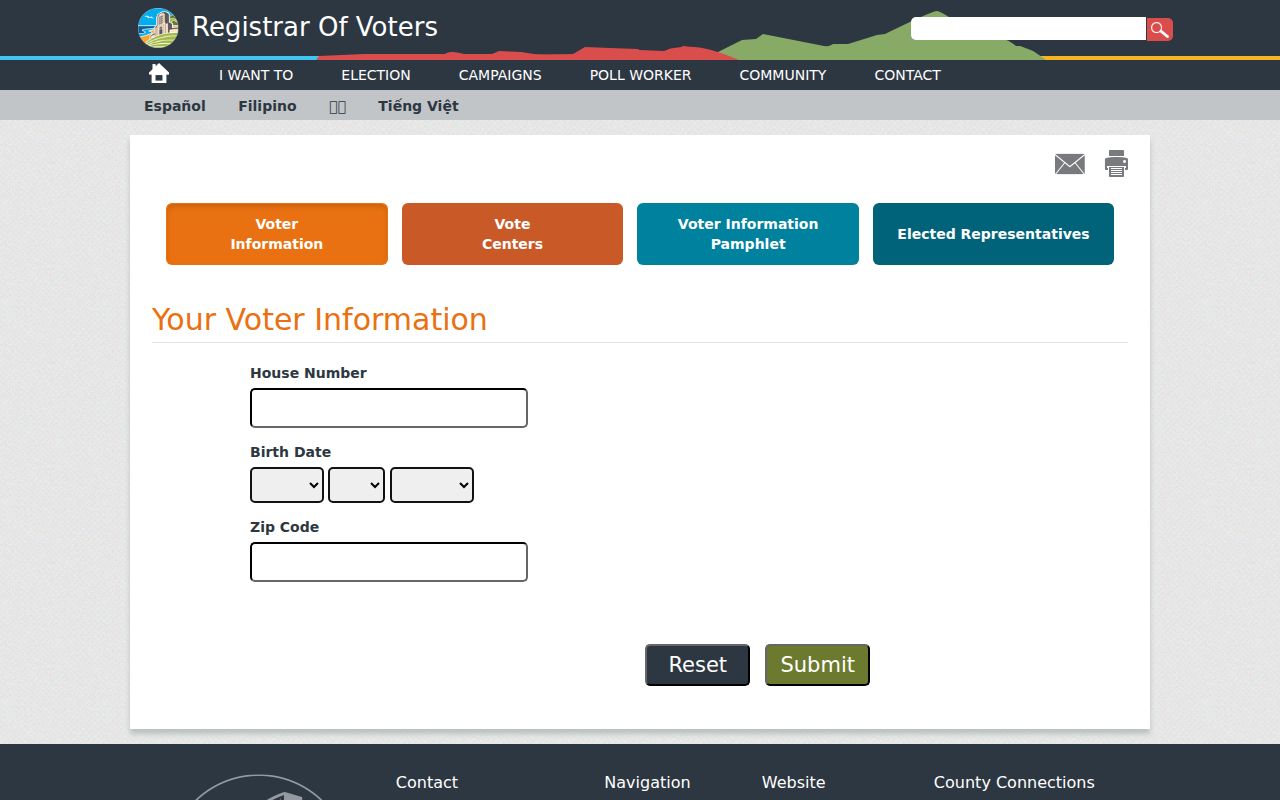
The captured form shows why a voter must know personal address details instead of searching the voter rolls by a person’s name.
San Diego Voter Lookup Choices
The county and state services overlap, but they serve different needs. San Diego County’s tool focuses on local election information tied to the validated address. The California Secretary of State My Voter Status provides a statewide check for political party preference, language preference for election materials, and vote-by-mail or provisional-ballot status. A voter who moved between California counties may find the statewide route useful, while local vote-center and representative details point back to the county system.
Neither service offers open public name browsing. Both are designed for a voter to check a personal registration record. A voter-file request is a different process, reviewed under state eligibility and use rules.
The statewide My Voter Status service gives California voters a second official route when a county lookup does not answer the question.
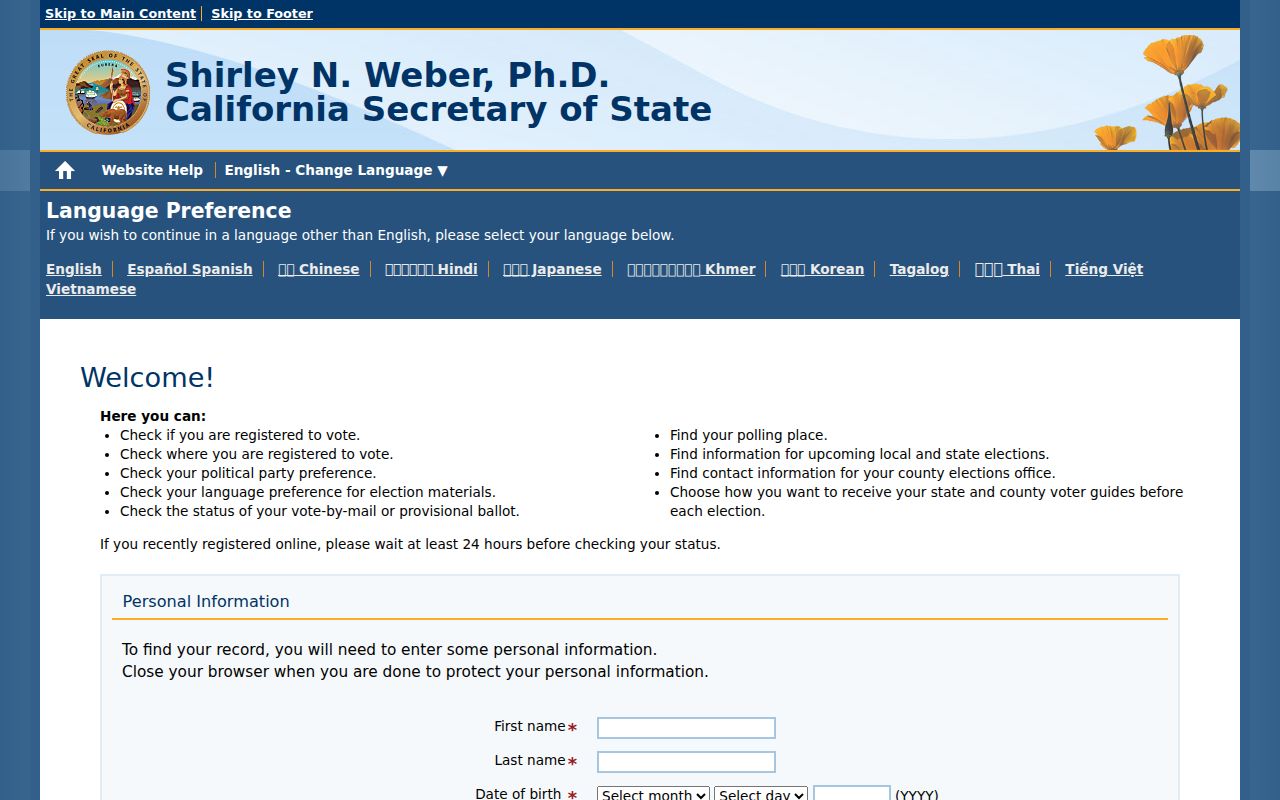
The state screen reinforces the self-service model: it is a status check, not a public directory of San Diego County residents.
Voter Records Are Not a Directory
California’s voter system separates personal status checks from approved access to voter information. That distinction matters for family research, scholarly work, election analysis, and journalism. A surname alone will not unlock the county portal. The local form requires address elements and a birth date, while the state file process requires an application, a qualifying purpose, and security duties.
Privacy boundary. Do not treat San Diego County voter records as an open name list or use registration data to stalk, harass, threaten, or harm anyone.
For ordinary personal verification, use the county or state status lookup. For an approved file purpose, use the Secretary of State application or ask the San Diego County Registrar about a county-only file. General access questions about other agencies follow different rules under San Diego County public records access.
San Diego Voter Record Fields
An approved California Voter Registration Data File can contain a voter’s name, date of birth, registration date, residential and mailing address, precinct, contact information, and political party preference. Active voters are included automatically. Inactive voters must be requested. These file fields are broader than the details a voter sees through a personal status check, so release depends on approval and stated use.
| Registration data | Name, date of birth, registration date, residential and mailing address, precinct, contact information, and party preference |
|---|---|
| Participation history | Election type, election date, and voting method when this separate file is requested |
| Political districts | Precinct number linked to district number and district type when requested |
| Inactive voters | Not automatic; the requester must specifically ask for them |
A participation record says whether and how someone took part, such as at a polling place, by conditional registration, or by vote-by-mail. It never reveals ballot choices. The political-district file maps precincts to their districts rather than adding a person’s votes or views.
San Diego Voter File Exclusions
Some information never appears in an ordinary approved release. Elections Code section 2194(b) excludes a California driver’s license number, state identification card number, the last four digits of a Social Security number, the statewide unique identifier, and a signature or digitized signature image. Pre-registration records for 16- and 17-year-olds are also excluded because those minors are not registered voters until age 18.
Confidential by law. Records protected under Elections Code sections 2166, 2166.5, 2166.7, and 2166.8 are not supplied to ordinary voter-file requesters.
Elections Code section 2166.9 creates a narrow route for confidential contact information of covered elected officials and candidates. The Secretary of State decides whether a request has a bona fide journalistic or governmental purpose. Government Code section 7924.000 and the state voter-access regulations add further controls. Approval for one file does not cancel these exclusions.
San Diego Voter File Eligibility
California permits access, subject to exceptions, for candidates for federal, state, or local office; committees supporting or opposing qualifying initiative or referendum measures; and people seeking data for election, scholarly, journalistic, political, or governmental purposes. A claimed purpose is not automatic approval. The Secretary of State reviews the application and determines whether access and intended use fit the law.
Recipients must follow the security and permissible-use conditions tied to the released information. Elections Code sections 2188, 2194, and 18109(b), California Code of Regulations sections 19001 through 19004, 19006, and 19008 through 19013, and Business and Professions Code section 17538.41 are among the authorities named by the Secretary of State. Selling, sharing, or repurposing the data outside the approved use can carry legal consequences.
Note: A request for election research is reviewed as a voter-file application, not handled as an unrestricted public name search.
Request San Diego Voter Data
The Secretary of State voter-file request process handles statewide files and requests for specified voters. San Diego County-only data can be requested from the county election official, whose fee may differ. The state says review normally takes 7 to 14 business days after receipt. Plan for review before expecting delivery.
- Select the needed scope: statewide registration data, up to ten named voter records, or a San Diego County-specific file. Request participation history or political-district data separately when needed.
- Complete the application and state an eligible election, scholarly, journalistic, political, or governmental purpose. Provide the required identifying details for each specified voter.
- Submit the fee and comply with the recipient security terms. Wait for approval before treating the requested data as available.
A single-voter request requires the full name, date of birth, county of residence, and residence address for each person. That identity requirement helps distinguish a precise record request from casual browsing.
San Diego Voter File Fees
State charges depend on scope. A statewide voter registration file costs $100. A request for a specific voter costs $30 per record, capped at $100 for up to ten records. A San Diego County-specific file has a fee set by the county and should be requested directly from the Registrar of Voters. The research does not establish one fixed county amount, so confirm it before filing.
| Request | Scope | Fee | Key condition |
|---|---|---|---|
| Statewide file | California voters | $100 | Qualified requester and approved application |
| Specified voter | Up to 10 records | $30 each, $100 maximum | Full name, birth date, county, and residence address |
| County file | San Diego County voters | Varies by county | Request from the county elections official |
| Confidential official contacts | Eligible statewide records | $15 per thousand, $100 maximum | Bona fide journalistic or governmental purpose |
For up to ten confidential elected-official or candidate records, the state lists $30 per record with a $100 maximum and requires full name and birth date. These special records do not belong in a routine file request.
San Diego County Registrar Help
The San Diego County Registrar of Voters manages the local lookup, registration services, vote-center information, voter pamphlets, and ballot tracking. The office is at 5600 Overland Avenue, San Diego, CA 92123. Call 858-565-5800 for general help. TDD service is 858-694-3441, the fax number is 858-694-2955, and the published email is rovmail@sdcounty.ca.gov.
Registrar of Voters
Registrar: Cynthia Paes
Address: 5600 Overland Ave, San Diego, CA 92123
Phone: 858-565-5800
Email: rovmail@sdcounty.ca.gov
Contact the county for a failed local status match, a county-file quote, or a question about local election materials. Contact the Secretary of State for statewide voter products and application review.
Protected San Diego Voter Addresses
California’s Safe at Home program provides a substitute mailing address and related protections for eligible survivors and other protected people. Separate confidential-registration provisions in the Elections Code shield qualifying voter records. These safeguards explain why an approved voter file is never a complete roll of every person connected with a San Diego County address.
A requester should not try to infer or reconstruct a protected residence from precinct, district, property, or other sources. Confidential status is a safety measure, not a missing-data error. For a voter who may qualify for protection, the correct route is the Secretary of State program and official enrollment guidance.
Early San Diego Voter Trails
Modern online tools are poor fits for historical voter research. The San Diego History Center notes that the early County Assessor handled voter registration, poll taxes, and the annual militia roll after the office was established in 1850. That history directs genealogists toward assessor and archival collections, even though the research did not verify an exact inventory of surviving historical poll books or voter-register volumes.
Use documented substitutes when a formal register cannot be identified. San Diego Public Library city directories cover 1886 through 2021, and its San Diego Union obituary microfilm begins in 1865. County deed indexes also provide long name trails. Those sources can establish residence and identity without claiming that a historical voter record survives. Do not present old poll books as online or complete unless an archive confirms the specific volume.